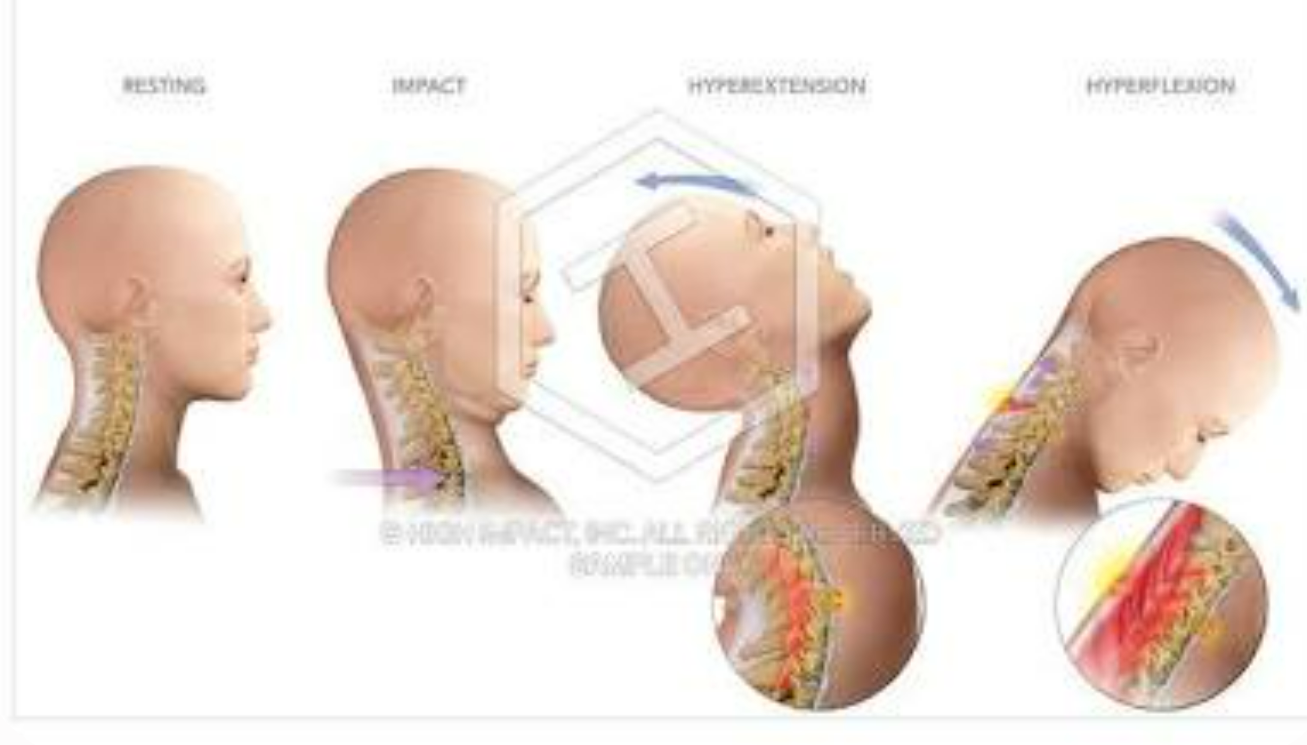
Whiplash is a common neck injury often associated with sudden, forceful movements of the head and neck. Whiplash is also known as whiplash-associated disorder (WAD), occurs when the neck is subjected to a rapid back-and-forth motion, resembling the cracking of a whip.
We recommend documenting neck and back injuries soon after the accident. There are many Urgent Care centers in Contra Costa County and they can x-ray you or at least document swelling and other signs that you may have suffered whiplash. If you don’t do this it will be your word against “theirs” as you claim to have suffered injuries in the accident. Our office knows that the other side seeks to minimize your injuries and if you missed the chance to go to the John Muir or Kaiser ER or an Urgent Care facility – we can work with that and establish other ways to prove your injuries. We are a local law firm with offices in Lafayette, Ca. We can help you with physician referrals if you need that. Meanwhile, this article helps explain why even a seemingly small impact can cause large injuries to your back and neck.
This injury most commonly results from rear-end car accidents but can also stem from sports injuries, physical assaults, or amusement park rides. The sudden motion strains or tears the soft tissues of the neck, including muscles, ligaments, and tendons. A 2019 study in The Spine Journal highlights that the rapid acceleration-deceleration forces can cause microtears in ligaments and muscles, leading to inflammation and pain. Additionally, the study notes that the cervical spine’s complex anatomy makes it particularly vulnerable to such injuries.
Scientific research elaborates that whiplash can affect not only soft tissues but also cervical facet joints, intervertebral discs, and nerve roots. This is important because the pain from the soft tissue injuries may lessen in a few months but the damage to disks, joints and nerves can get worse over months and years. In personal injury law the best attorneys pay attention to whiplash and they look at the medical records and doctor consults to see whether this long term joint and disk damage has been identified and documented.
Causes of Whiplash
The Mayo Clinic identifies the primary cause of whiplash as any event that causes the head to jerk violently forward or backward. Common scenarios include:
- Car accidents: Especially rear-end collisions, where the impact forces the head to snap forward and then backward.
- Sports injuries: Contact sports like football, rugby, or martial arts can lead to whiplash.
- Physical trauma: Falls, blows to the head, or assaults can trigger the injury.
- Amusement park rides: High-speed rides with sudden stops or turns may cause neck strain.
A 2016 study in Journal of Orthopaedics emphasizes that whiplash can occur in low-speed rear-end collisions, with speeds as low as 6.2–9.3 mph (10–15 km/h) sufficient to cause symptoms. The study notes that the risk is particularly high when the vehicle’s headrest is improperly positioned, as it fails to adequately restrain head movement. This underscores that even minor accidents can lead to significant neck injuries, especially if safety features are not optimized.
Symptoms of Whiplash
The Mayo Clinic lists several symptoms that typically appear within days of the injury, including:
- Neck pain and stiffness
- Worsening pain with neck movement
- Loss of range of motion in the neck
- Headaches, often starting at the base of the skull
- Tenderness or pain in the shoulders, upper back, or arms
- Tingling or numbness in the arms
- Fatigue and dizziness
Less common symptoms may include blurred vision, ringing in the ears (tinnitus), sleep disturbances, irritability, difficulty concentrating, memory problems, and depression. These symptoms can vary widely in intensity and duration.
A 2021 article in Pain Medicine provides deeper insight, noting that whiplash can lead to chronic pain in 20-40% of cases, a condition known as chronic whiplash-associated disorder (CWAD). The study suggests that central sensitization—where the nervous system becomes hypersensitive to pain signals—may contribute to persistent symptoms. Additionally, psychological factors like stress or anxiety can exacerbate symptoms, creating a complex interplay between physical and mental health.
Risk Factors and Complications
The Mayo Clinic outlines risk factors for whiplash, such as involvement in high-speed collisions or participation in contact sports. Complications may include chronic neck pain, prolonged headaches, or, in rare cases, damage to the spinal cord or nerves.
Research from The Lancet (2018) emphasizes that women are at higher risk of developing chronic symptoms due to anatomical differences, such as smaller neck muscles and less cervical spine stability. The study also highlights that early onset of severe pain or neurological symptoms (e.g., numbness) increases the likelihood of long-term complications.
The Journal of Orthopaedics (2016) further notes that low-speed accidents can still pose significant risks, particularly for individuals with pre-existing neck conditions or poor posture, as these factors amplify the strain on cervical tissues during sudden movements.
Diagnosis and Treatment
While the Mayo Clinic’s webpage focuses on symptoms and causes, scientific literature provides more detail on diagnosis and treatment. Diagnosis typically involves a physical exam, medical history review, and imaging tests (e.g., X-rays, CT scans, or MRIs) to rule out fractures or other injuries. A 2022 study in Clinical Biomechanics underscores the importance of assessing cervical range of motion and muscle strength to gauge injury severity.
Treatment often includes:
- Pain management: Over-the-counter pain relievers, ice/heat therapy, or prescription medications for severe pain.
- Physical therapy: Exercises to restore range of motion and strengthen neck muscles.
- Rest and immobilization: Short-term use of a cervical collar may be recommended, though prolonged immobilization can delay recovery.
- Lifestyle adjustments: Ergonomic changes and stress management can aid recovery.
For chronic cases, a 2020 study in The Journal of Pain advocates multidisciplinary approaches, combining physical therapy, cognitive-behavioral therapy, and, in some cases, injections or nerve blocks to manage persistent pain.
Prevention Tips
Preventing whiplash involves minimizing exposure to high-risk activities and optimizing safety measures. The Mayo Clinic suggests using properly adjusted headrests in vehicles and wearing protective gear in sports. The Journal of Orthopaedics (2016) reinforces the importance of headrest positioning, noting that a headrest aligned with the top of the head and close to the skull (within 2 inches) can significantly reduce whiplash severity in low-speed collisions. Research from Accident Analysis & Prevention (2019) adds that advanced vehicle safety systems, such as automatic emergency braking and adaptive headrests, can further mitigate risks.
Anatomy is a factor as well. People with strong necks and shorter necks fare better during an impact because there is less movement of the neck, less extension and less flexion as well.
Conclusion
Whiplash is a multifaceted injury with a wide range of causes, symptoms, and outcomes. While the Mayo Clinic provides a solid foundation for understanding the condition, scientific research, including studies on low-speed collisions, reveals its complexity. Even minor accidents can cause significant injury, particularly when safety features like headrests are not properly adjusted. Early intervention, proper diagnosis, and tailored treatment are crucial for recovery, while preventive measures can reduce the risk of injury. By combining insights from clinical sources and research, we gain a fuller picture of whiplash and its impact on health.
From a personal injury case standpoint documenting whiplash can be the difference between a settlement offer that is unfairly low and a settlement that is fair and appropriate. It is important to remember that whiplash symptoms can be mild for years but get worse over time. The damage in many cases heals 100% but in cases where there is residual injury time and normal aging can make the symptoms worse. We are a local law firm and your interactions with are staff are personal. We use this relationship to work with you to document the (often) subtle changes that whiplash can cause and we work with you and your chiropractor or doctor to document these changes. In the past we had issues with Kaiser because they tended to minimize accident injuries for reasons that we considered economic [less treatment needed if they minimize the injury]. We work with the Kaiser system to ensure that they are reimbursed for the care they provide – not from your pocket but by getting an accident settlement that is large enough to compensate Kaiser, you and your lawyers. Win, Win, Win. In any case, personal attention and documentation of whiplash injuries is a team effort and important to ensure that you receive a full and fair settlement in your accident case.
References
- Mayo Clinic. (n.d.). Whiplash: Symptoms & Causes. Retrieved from https://www.mayoclinic.org/diseases-conditions/whiplash/symptoms-causes/syc-20378921
- Veronese, N., et al. (2016). Minimum jerk model and headrest positioning in whiplash. Journal of Orthopaedics, 13(4), 401–405. https://doi.org/10.1007/s10195-016-0431-x
- The Spine Journal. (2019). Biomechanics of Whiplash Injuries.
- Pain Medicine. (2021). Chronic Whiplash-Associated Disorders and Central Sensitization.
- The Lancet. (2018). Risk Factors for Chronic Whiplash Symptoms.
- Clinical Biomechanics. (2022). Diagnostic Approaches to Cervical Spine Injuries.
- The Journal of Pain. (2020). Multidisciplinary Treatment for Chronic Whiplash.
- Accident Analysis & Prevention. (2019). Vehicle Safety Systems and Whiplash Prevention.
Leave a Reply